
Dig Around Live Services Without the Risk of Hitting Them
Vacuum excavation, PAS 128 Type A verification and borehole clearance from Castle Surveys’ Vac-Ex Division, so your excavations open safely and your programme keeps moving.
Every civils team, tier 1 contractor and ground investigation crew knows the moment. The excavator’s in position, the programme’s tight, and nobody’s quite sure whether that line on the drawing is real, or whether something else sits just beside it that isn’t on any drawing at all. Our vacuum excavation services exist for exactly that moment. Instead of a bucket or a spade feeling its way through the ground, we use high-powered suction to remove spoil around buried services, exposing them intact so you can see what’s there before anything heavier goes in.
What Is Vacuum Excavation?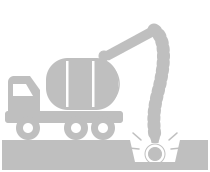
Vacuum excavation (often called vac ex, suction excavation or non-destructive digging) is a way of excavating ground without mechanical digging. Compressed air or pressurised water loosens the soil, and a powerful vacuum unit draws the spoil up a hose into a sealed tank on the truck. Nothing hard touches the service; the ground is simply lifted away from around it.
There are two main approaches. Air vacuum excavation uses an air lance to break up the ground and leaves dry spoil that can often be reused for backfill. Water based vacuum excavation (sometimes called hydro excavation) suits heavier clays and compacted ground, where water cuts through faster. We choose the method for the ground and the job, not the other way round.
Here’s the thing. A spade can’t tell the difference between clay and a fibre duct, and neither can a bucket. A vacuum excavator doesn’t need to; it exposes services rather than finding them by accident.
Why Service Strikes Still Stop Jobs
Most service strikes aren’t caused by a lack of effort; they’re caused by trusting information that was never good enough to dig on. Statutory records are often years out of date, private networks rarely appear on them at all, and a quick CAT and Genny sweep only finds what’s conductive and carrying a signal. Plastic water mains, fibre ducts, abandoned cables that turn out to be live… they all slip through.
We’ve seen it happen more times than we’d like. A package stops while an incident is investigated and the client starts asking awkward questions. A GI crew loses half a day because a borehole has to be moved at the last minute. The repair bill is frustrating, but it’s the programme slippage, the stood-down plant and the near miss report that really follow a project around.
So how do you dig around live services safely, at pace, without hand digging every metre?
Vacuum Excavation for Tier 1 Contractors and Civils Teams
For tier 1 contractors, the challenge is usually scale. You need services exposed and proven across a whole scheme, often in live carriageways and congested urban plots, and you need it done without slowing the programme.
Our vacuum excavation contractors carry out the work that typically sits on a tier 1 critical path:
Trial holes and slit trenches. Services located and exposed to confirm clashes before design freeze or a drainage run is set out.
Safe excavation around live services. Exposing gas, water, electric and telecoms apparatus intact, so mechanical excavation can follow with a clear view of what’s in the ground.
Pre-clearance for foundations and piling. Pile positions, piling mats, crane bases and temporary works cleared before heavy plant arrives.
Utility diversions and new connections. Opening up around existing apparatus so connections and diversions can be made without damage.
Restricted access and urban sites. Footpaths, carriageways and tight plots where records are least reliable and a strike would cause the most disruption.
Ever had a design held up because nobody could confirm the depth of a single main? A vac ex trial hole is usually the quickest way to unblock it.
PAS 128 Type A Verification by Vacuum Excavation
PAS 128 is the UK specification for underground utility detection, verification and location. It splits utility mapping into survey types, so everyone on a scheme knows how much confidence to place in each line on the drawing.
Type D (desktop). A search of statutory and private records.
Type C (site reconnaissance). Visible evidence on the ground, such as covers, valves and marker posts, tied back to the records.
Type B (detection). Electromagnetic location (EML) and ground penetrating radar (GPR), including the IDS Stream C-thru array where coverage matters, to detect and map services with a quality level for each.
Type A (verification). Services physically exposed, usually by vacuum excavation, so position, depth, type and material are confirmed by eye.
That last one deserves a moment. A Type B survey tells you where a service probably is. Type A verification by vacuum excavation tells you where it definitely is, and it’s the level you want wherever a strike would be costly or dangerous. Because our surveyors and our Vac-Ex Division work side by side, we can take you from desktop search to verified, photographed services in one joined-up programme.
Borehole and Trial Pit Clearance for Ground Investigation Contractors
For ground investigation contractors, the risk is concentrated in the top metre or so of every location, and that’s the part a rig is worst at feeling its way through. Hand dug inspection pits help, but they’re slow, physically hard on the crew, and still carry the risk of a spade through a cable.
Our borehole clearance service uses vacuum excavation to take that risk off the rig. We scan the area around each location, mark out what we find, then vac ex an inspection hole at the borehole position down to the agreed clearance depth. Your driller arrives to a proven, open start, with a record of what was found (and what wasn’t) for the RAMS and permit to dig. The same approach works for trial pit clearance, window sampling, dynamic probing, cable percussion and rotary locations.
Why Choose Castle Surveys for Vacuum Excavation?
In our experience the riskiest part of service clearance isn’t the scanning or the digging. It’s the handover between them. When the survey comes from one company, the vacuum excavation from another and the site crew from a third, information gets lost and nobody owns the final answer.
We do it differently. Castle Surveys delivers all of its work in-house with no subcontracting, so the team who maps your services is the same team who exposes them by vacuum excavation and signs off the result. One programme, one point of contact, one set of drawings that actually matches what’s in the ground.
What You Get, and What It Means for You
- Vacuum excavation by our own Vac-Ex Division. Services exposed intact by suction rather than struck by a bucket, so your excavations open safely and on programme.
- Air or water excavation, matched to the ground. The right method for clays, gravels or made ground, so progress stays quick without compromising safety.
- PAS 128 Type A verification. Critical services exposed, measured and photographed, so you can sign off a dig plan with real confidence, not caveats.
- Borehole and trial pit pre-clearance. Locations soft dug before the rig arrives, so drilling starts on time and nobody’s guessing at the top metre.
- One in-house team from scan to dig. Fewer handovers and fewer gaps, with a single contact who owns the result from start to finish.
- Fully accredited, clean audit trail. CHAS Elite and Constructionline Gold, with ISO 9001 aligned processes, so procurement and H&S sign-off are quick to get through.
- Records your team can use straight away. Verification logs, depths, photographs and CAD drawings, ready to drop into your RAMS, permit to dig and design model.
Where We Provide Vacuum Excavation Services
From our head office in Ashby de la Zouch, Leicestershire, our Vac-Ex Division provides vacuum excavation across the East Midlands, South Yorkshire and Lincolnshire, including Leicester, Nottingham, Derby, Sheffield, Doncaster and Lincoln. With further offices in Manchester, London, Cheltenham and Scotland, we support contractors and ground investigation firms on schemes across the UK.
Vacuum Excavation Frequently Asked Questions
Our focus is environments: sets, locations, streets and landscapes. For full-body or facial capture you’ll want a specialist booth studio, and we’re happy to work alongside them on the same production.
It depends on size and detail. A small set might take an hour or two; a large exterior could take a day. We’ll give you a realistic estimate once we’ve seen the brief and, ideally, a few location photos.
Yes. Most of our on-set scanning happens during breaks, before call or after wrap. We’ll plan it with your team so the unit keeps moving.
No problem at all. Plenty of larger VFX facilities prefer to mesh the point cloud themselves, so we’ll deliver registered E57 data to their specification.
Often, yes. Mobile mapping and drones can gather a location quickly and with minimal disruption, so artists can rebuild it later rather than sending a full crew.