Hydrographic Survey Solutions by Expert Marine & Waterway Surveyors
Water hides a lot. A riverbed, a harbour floor, the base of a reservoir; you can’t just look at it and know what’s down there, and that’s precisely the problem a hydrographic survey solves. At Castle Surveys, we’re a hydrographic survey company that deals in decision ready data, not just a stack of raw depth readings you’re left to make sense of yourself. Every reading we take is captured with the end use already in mind, whether that’s a dredging design, a cable route, or a planning submission that needs to stand up to scrutiny.
Marine construction, offshore energy and coastal engineering projects all share one thing in common: they depend entirely on accurate seabed and waterway data before design work can even begin. Get that data wrong, or work from something incomplete, and the consequences don’t stay hidden for long; they show up as a foundation that doesn’t sit where it should, or a cable route that meets an obstruction nobody knew was there. We’ve built our hydrographic surveying capability specifically to close that gap, combining a highly trained team with genuinely sophisticated marine equipment.
What is a Hydrographic Survey?
Hydrographic surveys are an essential tool for underwater mapping, and industries across the marine, construction and energy sectors rely on them to keep operations safe and efficient. Put simply, a hydrographic survey builds an accurate picture of what’s happening beneath the water’s surface, information that’s practically impossible to gather any other way.
Understanding Hydrographic Surveys
Using advanced GPS, sonar and echo sounding technology, these surveys measure water depth, map the seabed and detect any submerged structures that might otherwise go unnoticed until they cause a problem. It’s a bit like giving a site the equivalent of an MRI scan; you’re seeing detail that would otherwise stay hidden until something went wrong on site.
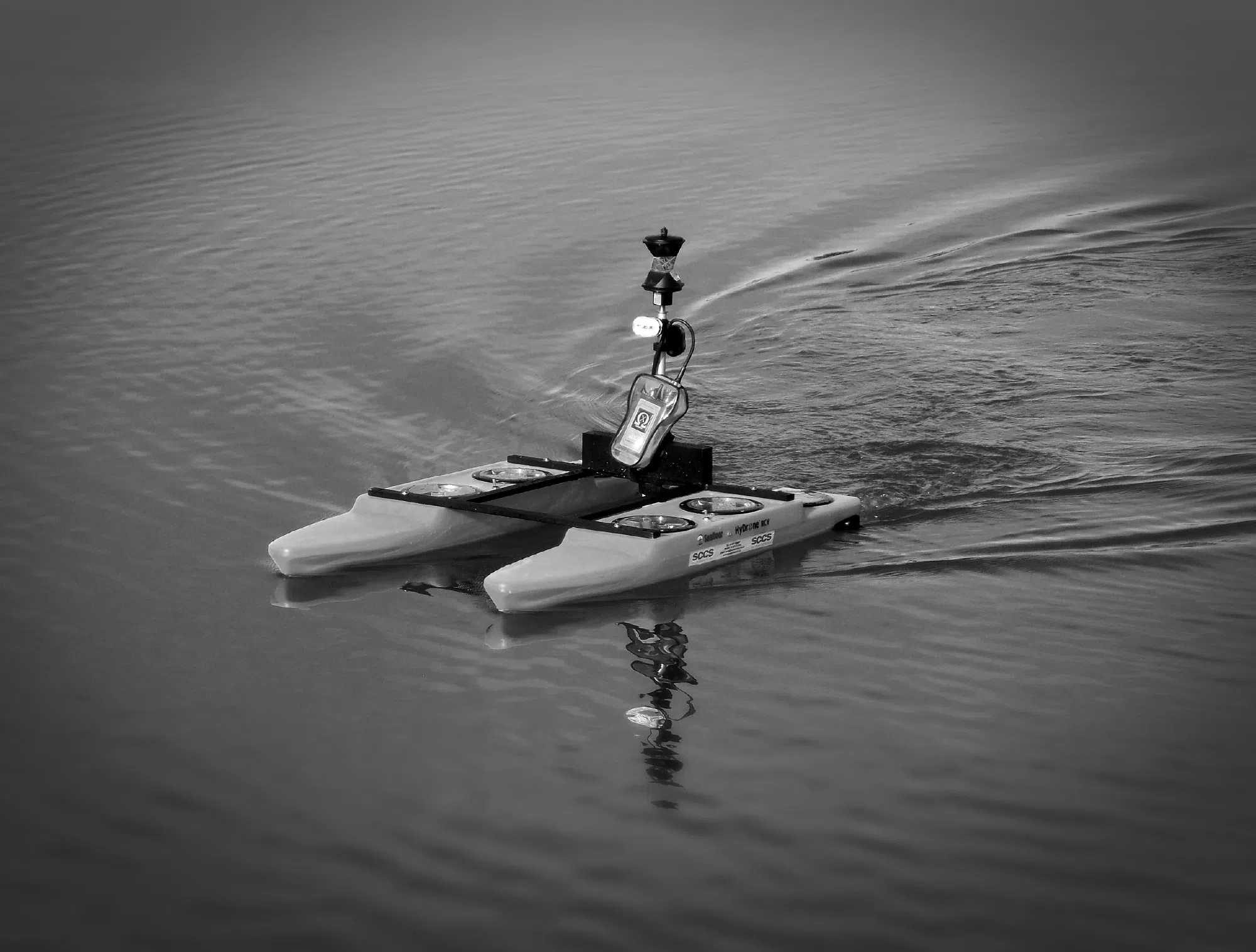
We also draw on side scan sonar, which produces detailed imagery of the seabed surface, genuinely useful for spotting wrecks, debris or other obstructions that a standard depth reading alone would miss. For larger or more hazardous stretches of water, we deploy uncrewed survey vessels (USVs and ASVs), which let us capture data across areas that would be slow, difficult or simply not worth the risk to survey conventionally. Establishing accurate control on the surrounding land matters just as much as the underwater work itself, and that’s often where our topographic GPS/GNSS surveys come in, tying the waterborne data into a single, coherent coordinate framework.
The Role of Bathymetric Surveys
Bathymetric surveys are a key component of hydrographic surveying. These use single-beam and multibeam sonar systems to measure water depths and profile the underwater landscape, generating detailed topographic maps of river beds, sea floors and reservoirs. This data is crucial for projects like port development, dredging projects and environmental monitoring.
REQUEST A QUOTE
What Does a Hydrographic Survey Include?
As standard, a Castle Surveys hydrographic survey captures a comprehensive picture of the waterbody in question, both what’s on the seabed and what’s moving through the water above it. Here’s what that typically covers.
Bathymetric Data & Seabed Profiling. Precise depth measurements across the survey area, building an accurate model of the seabed or riverbed’s shape and gradient.
Underwater Obstructions & Submerged Structures. Wrecks, debris, pipelines, cables and any other feature that could affect construction, navigation or dredging works.
Sediment Composition & Seabed Classification. An understanding of what the seabed’s actually made of, rock, sand, silt, which matters enormously for foundation design and dredging planning.
Tidal & Water Level Data. Water level variation over time, essential for converting raw depth readings into meaningful, chart referenced data that engineers can actually design against.
Castle Surveys’ Hydrographic Surveying Process
At Castle Surveys, our surveys follow a three step process, refined over years of working on genuinely varied sites, from tight inland waterways to open estuary crossings.
Initial Consultation and Requirements Assessment
Every survey begins with a collaborative meeting to understand your exact project needs. We work closely with you to define objectives, identify any challenges, and determine the most effective survey methods to use. By tailoring our approach for every project, rather than reaching for a one size fits all method, we make sure you get the most accurate and relevant survey data for what you’re actually trying to achieve. It’s a conversation, not a form to fill in, and it’s usually where the trickier constraints on a project first come to light.
Advanced Technology and Techniques
Our state of the art waterway surveying technology lets us capture incredibly precise underwater data. Using advanced sonar systems, including single beam and multi beam echo sounders, we generate high resolution underwater mapping that holds up under close engineering scrutiny. We also use GPS positioning, side scan sonar and more to detect seabed composition, potential hazards and other underwater features, and where a project spans both land and water, we can align this with aerial data from our aerial topographic surveys to build one continuous picture of the whole site.
Deliverables and Reporting
After data collection and processing, we deliver clear, detailed reports tailored to each client’s needs; see the full breakdown of formats and applications below.
Why Do I Need a Hydrographic Survey for My Project?
Supporting Marine Construction Projects
Whether for port expansions, bridge foundations, underwater pipelines or offshore wind farms, marine survey services are vital for ensuring safety and stability. Coastal surveys identify submerged obstacles, sediment composition and depth variations, helping engineers plan and implement solutions that can genuinely withstand underwater marine conditions rather than just hold up on paper.
Ensuring Environmental Compliance
Environmental regulations require that bodies of water are carefully assessed before and during any construction activity. Hydrographic surveys help developers comply with these regulations by providing detailed insight into water depth, sediment movement and ecological impact, a wealth of subsurface data that supports sustainable development and helps protect the ecosystems around it. It’s not just a compliance formality either; getting this data right at the outset tends to head off the kind of environmental objection that can stall a project for months once it’s already under way.
Enhancing Navigation Safety
Accurate waterway surveys help maintain safe navigation in bodies of water of all types. Detailed navigation surveys identify hazards such as wrecks, submerged rocks and shifting sandbanks, so vessels can navigate through safely, reducing the risk of grounding and the kind of accident that’s expensive in every sense of the word.
Tailored Technical Deliverables for Marine & Engineering Integration
Capturing accurate data underwater is only ever half the job. The other half is making sure that data lands in your hands in a format your team can actually use, and that’s an area where a lot of providers quietly fall short. All of our data processing happens in house, handled by our own team to the precise specification you’ve requested, rather than being passed off to a third party who’s never seen your project.
We run a thorough verification process on every dataset, checking that coordinate systems and datums, whether that’s Chart Datum, OSGB36 or WGS84, are applied correctly and consistently throughout. Get a datum wrong on a marine project and the error doesn’t stay small; it compounds across every downstream calculation, from dredge volumes to foundation levels, and that’s exactly the kind of mistake we build our process to prevent.
Here’s a quick reference for the deliverable formats we typically produce, and where they tend to get used:
| Deliverable Type | Format / Extension | Common Project Application |
| Bathymetric Charts & Seabed Maps | .DWG/.DXF, GIS shapefiles | Port development, navigation charts, planning submissions |
| Digital Terrain Models (Seabed) | XYZ, LandXML, Civil 3D Surfaces | Dredging design, cut and fill/volumetric analysis |
| Side Scan Sonar Imagery | Geo referenced GeoTIFF mosaics | Obstruction/wreck detection, cable & pipeline route surveys |
| Raw Survey Data | XYZ, CSV | GIS integration, further engineering analysis |
| 3D Models | Revit/BIM | Scan to BIM for marine structures, digital twins |
Why Choose Castle Surveys as Your Hydrographic Surveyors?
Nationwide Hydrographic Surveying Services from Our Regional Hubs
One question we hear constantly is whether we can actually cover a particular stretch of water. In almost every case, yes, and without the long lead times some providers seem to need. We operate from regional hubs across the country, keeping us close to the water wherever your project happens to sit.
Midlands (HQ). Our home ground, covering inland waterways, canals, reservoirs and river surveys across the Midlands’ genuinely extensive canal network, one of the densest in the country.
London & The South East. Thames Estuary navigation, port and marina developments, and dense tidal waterway environments that demand a survey team comfortable working around busy commercial traffic.
Manchester & The North. Canal networks, reservoirs and industrial waterway infrastructure across the North West and Yorkshire, much of it built well over a century ago and needing a careful, informed approach.
Cheltenham & The South West. Rivers, estuaries and coastal developments along the South West coastline, where tidal ranges and exposed conditions call for genuine local knowledge.
Glasgow & Scotland. Lochs, sea lochs, harbours and offshore energy projects across Scotland’s coastline, a region where the scale and remoteness of some sites make a nationwide capability genuinely valuable.
Sector Specific Hydrographic Expertise & Risk Mitigation
Marine & Port Infrastructure. Supporting safe berth design, dredging planning and quay wall stability assessments with data that stands up to the scrutiny these projects demand.
Renewable Energy (Offshore Wind & Marine). Seabed data for cable routing, turbine foundation planning and site feasibility, feeding directly into the kind of decisions that carry serious cost implications if they’re based on incomplete information.
Construction & Civil Engineering. Foundational data for bridges, flood defences and waterside structures, giving engineers the confidence to design against real seabed and water level conditions rather than assumptions.
Environmental & Ecological Consultancy. Sediment and water data that supports compliance work and impact assessments, helping consultants build a case that’s grounded in accurate, defensible survey data.
Want to see how hydrographic data fits alongside a wider site picture? For projects with a landscaping or estate element bordering water, our landscape architect surveys often work hand in hand with our marine and waterway capability to give designers a complete, joined up dataset.
Schedule a Consultation
Whatever’s beneath the surface of your site, a pond, a busy tidal estuary, a working port, the principle stays the same: you can’t design safely against what you can’t see, and guessing simply isn’t good enough on a project of any real value. Castle Surveys delivers precise, tailored hydrographic surveys from regional hubs across the UK, processed entirely in house and formatted exactly the way your team needs it. Get in touch with our hydrographic surveyors today, even if you’re still at the stage of working out what your project actually needs; we’re happy to talk it through.
Frequently Asked Questions about Hydrographic Surveying
Explore Related Services
In addition to hydrographic surveys, Castle Surveys offers a variety of complementary services to support your project from start to finish:
- Boundary Surveys: Clearly define your property lines in coastal and waterway developments. Learn more about our boundary surveys.
- Topographic Land Surveys: Detailed land elevation data for seamless integration with hydrographic mapping. Discover our topographic land surveys.
- Measured Building Surveys: Precise data on existing structures. Explore our measured building surveys.